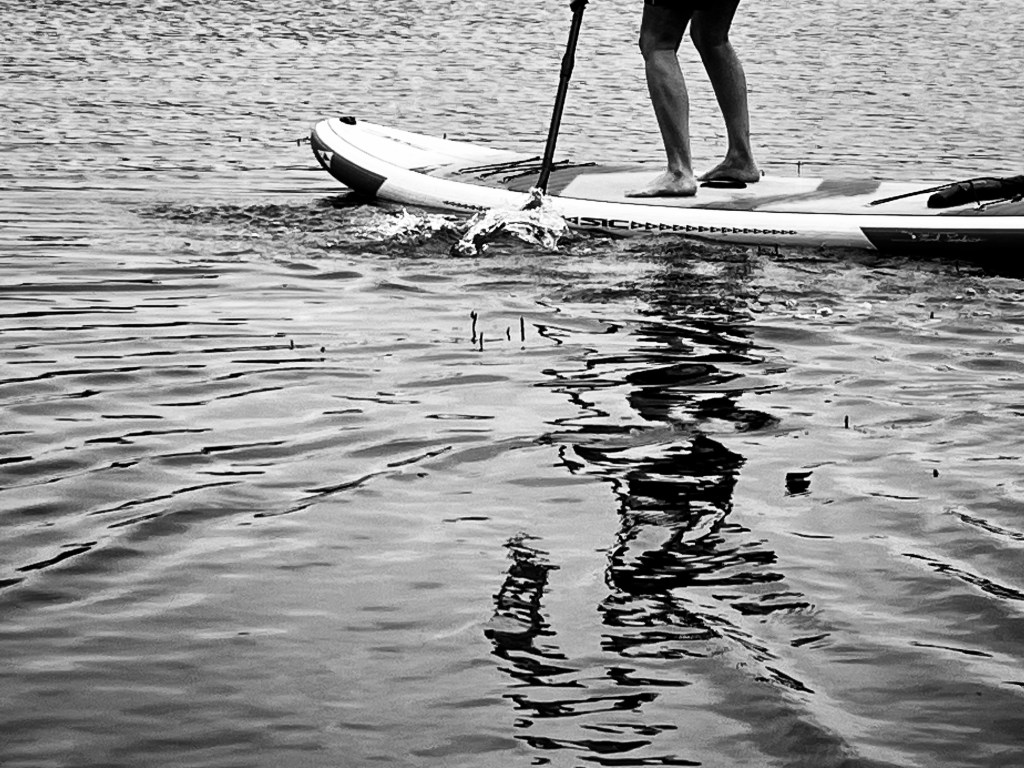
I am smack dab in the middle of a mirror-smooth lake in rural Michigan. I stand solidly on my borrowed paddleboard, knees soft, toes spread. The almost imperceptible heave of green water below me and the orange-blue morning sky above. I suck in damp cool air and try to remember what I’ve been taught: The label side of the paddle in front and top arm straight. Bury the blade and keep the stroke close to the board. But the lesson that looms largest is what I heard months before, advice that helped inspire me to try this in the first place. It came from a competitive standup paddleboarder named Alice.
Here’s how it went: As we walked her two big dogs near her home, Alice mused casually about this sport she’s so good at. My ears perked up because I love it when masters reflect upon their passions. Whether it’s the condor guy at the San Diego Zoo, the bassoonist on NPR, or the plumber repairing the old boiler where I work, I will stand in rapt attention when an expert speaks from the assured perch of their practiced excellence. Part of the attraction is of feeling welcomed into a private, elite world, one in which arcane secrets might be disclosed. I was struck, then, by the simple humility of Alice’s philosophy: “I fall off all the time. If you fall off, you just climb back on.”
She does, of course, have tons of specific technical expertise to share, but it was both the Buddhist quality of her advice and its timing that burned her words into my brain. And there was also the impact on me of my own surprise: I had, apparently, expected there to be a chasm of contrast between this elite practitioner and me, an almost species-level difference that would account for her ability to take on such challenges while I was destined to merely stand on the sidelines. Her advice didn’t just make the sport more approachable to me, it helped make me aware of a more general excuse that I have relied on from time to time over the years: That this or that interesting, difficult path or activity is for other people, special people, “those” people. That I, by contrast, am meant to observe from the shore, the ruminator who watches and analyzes, the diffident philosopher who categorizes and critiques, transmuting life-stuff into third-person descriptions.
Alice’s words wouldn’t have mattered so much, then, if they were only about paddleboarding. But what I heard (and what I think she meant) applies to life in general. And it highlighted for me my unspoken, occasional suspicion that life itself — this very thing we are here as earthlings to do— is for other people and not for me. Dynamic, extroverted, courageous people. People who are part of the swim of things as a matter of temperament and fate. Folks who leap into the game, willing to risk their fortunes, their limbs, and hearts for a shot at cracking open the world and realizing their dreams. But “people like me,” at least according to this story I have sometimes conveniently attached myself to, cling to security. We build our retirement accounts and keep the peace, unwilling to face choppy waters where we are likely to be thrown off our boards.

What I quickly recognize as absurd here, though, is that (like so many of the narratives most of us weave about ourselves), this story of me is demonstrably mythological. There are, to be sure, numerous plot points that I could rally in support of this account, but there are far more that contradict it. There is simply no disputing the fact that I qualify as a basically courageous person. Over and over again, I have dived in, shifted course, and thrown all my chips on the table. I have broken bones in the pursuit of small victories, been willing to humiliate myself in multiple arenas (and in multiple languages), and stared down internal demons that I’m pretty sure were planning to kill me. I have endured ridicule, battled for justice, and sometimes told the truth about love and desire. Although, sure, I am a little bit tentative about water sports (and lots of other things), I have, by and large, been living bravely.
This is not because I have been gifted with exceptional intelligence, discipline, or creativity — I have not — but because, as it happens, I actually do know how to fall and get back up. Somewhere along the way, and with the support of beautiful, wise guides, I seem to have gotten pretty good at it. And, in the process, I have also come to understand that suffering a cracked finger, bruised tailbone, or broken heart isn’t a sign that I’m “doing it wrong.” Our scars are not meant to be read as a map of error and stupidity.
Rather, flailing, failing and falling well is the whole point. The master’s lesson about getting back up on our feet, then, isn’t just a pep talk to help novices improve at a particular activity — I do not learn to fall simply so I might become better at paddleboarding (or skiing or karate or whatever). No. I choose this or that challenging activity — I choose to live with courage— so that, in this precious lifetime, I might become a virtuoso at resilience.
If you’d like to be notified by email of new posts, hit the menu button above to find the link to subscribe.
 OtherWise Philosophy