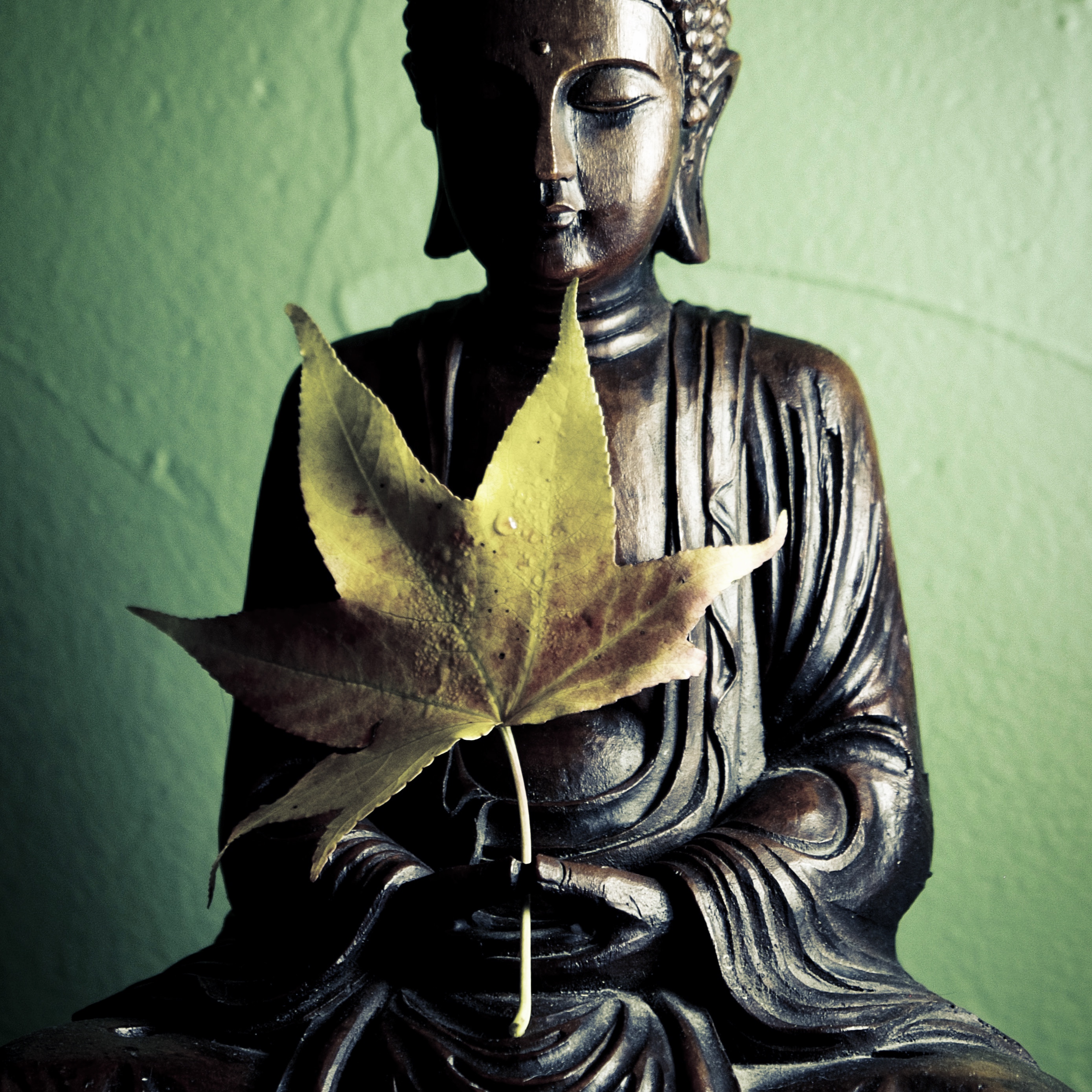
There is an old saying in Buddhist circles that we are called human BEINGS and not human DOINGS for a reason. It’s partly meant to remind us not to lose ourselves in rote activity and mindless busyness. Not only do many of us habitually give in to the chronic temptation to distract ourselves through compulsive activity—media consumption, shopping, exercise, work, travel, and on and on—we may even be proud of being so “active” and “involved.” Against this backdrop of constant activity, it’s surely useful to remind ourselves that we are human BEINGS and not human DOINGS. We may even take action in response to this spiritual truism by taking a nature walk, meditating, or stopping to smell the roses. But I think this being-doing distinction may also obscure something important about the fact that to be a human being is also to be a DOER, albeit one who might aim to be more skillful, intentional, and spiritually grounded.
The importance of intentional DOING is, in fact, at the heart of Buddhism, so it’s no accident that the Buddha includes some quite specific precepts regarding conduct on The Noble Eightfold Path. For example, he urges his followers to avoid idle chatter, lying, jobs that result in harm to others, and becoming intoxicated. And he encourages meditative practices and activities necessary to take basic care of the body. So-called socially engaged Buddhists have picked up on the importance of “right action.” In fact, the developmental history of Buddhism is marked by the degree to which various schools include, or even encourage, “normal” life activities, as compared to, say, sitting in a cave or monastery and meditating. Nonetheless, to many of us, the iconic, ideal spiritual seeker is one who eschews worldly activity (even if we ourselves do not choose to live our lives this way). From this point of view, the popular human BEING/DOING saying might be heard both as an admonishment to slow down and do less, and also as a recommendation to spend more time and energy on “spiritual” activities such as sitting meditation and yoga.
But this oversimplification may tempt us to race past the point that almost any activity — including supposedly spiritual ones — can become opportunities for ongoing distraction if self-avoidant escape continues to be one’s primary commitment. If what truly motivates an activity is either to run away from uncomfortable sensations and experiences or to grasp more tightly onto pleasurable ones, then, regardless of the specific content of that activity, it will be relatively shallow. Anyone who has ever used their sitting meditation practice to indulge in self-pity sessions, party planning, or sexual fantasy knows that even this most basic and Buddhist of practices can easily become just one more form of self-avoidance. And, from the opposite side of things, some people have experienced feeling fully present and self-possessed even in the very midst of worldly chaos and crisis. Although it’s probably true that, for most of us, a quiet environment is most conducive for cultivating inward communion, there is nothing inherently un-spiritual about an activity-filled life.

This distinction is also reflected in the Taoist notion of Wu-Wei, of “action without action” or “effortless action,” I think. In rough terms, the idea is that, when action emerges naturally, originating and arising from the deepest energies of the universe and then through oneself, it is qualitatively distinct from when it is generated by one’s mentalizing, ego-based, personality-level identity. Ego-based activity has the tendency to be stilted, partial, and ultimately unsatisfying, and it often shows itself when we attempt to manipulate or control circumstances or people (both others and ourselves). Rather than facilitating the natural and fluid outcomes of particular conditions in specific contexts—to accept and work with reality—we may, instead, try to use our minds and bodies to brute force outcomes that, at the moment, feel more comfortable or desirable to us. From this point of view, an action that is authentically rooted, be it a Tai Chi pose or the washing of a dish, is qualitatively distinct from one that is shallowly motivated. Again, it is the HOW of the doing that matters most.
I appreciate that what I say here could be twisted to provide yet one more rationalization for avoiding so-called spiritual activities such as meditation and indulging in worldly busyness. So I’ll quickly acknowledge the sort of obvious fact that taking a yoga class or sitting quietly under a tree can help foster the conditions for spiritual exploration. When we are able and willing to take sobriety breaks from our busyness benders, it can be a step towards doing vital inner work. But at the same time, I am put off by characterizations of supposedly spiritual activities as somehow intrinsically worthwhile when, for many of us, these too serve mainly as more fodder for distraction. As valuable as they can be, then, when practices like yoga and meditation become just two more tasks to cross off my self-improvement/self-care list, they’re no longer really tools of awakening. Rather they have become performances on the cushion or mat that reinforce the illusion that we’re stopping—that we’re BEING rather than DOING—when, in fact, we may be running faster and harder than ever.
If you’d like to get an email when I make a new post, hit the menu button above to find the subscribe link.
 OtherWise Philosophy