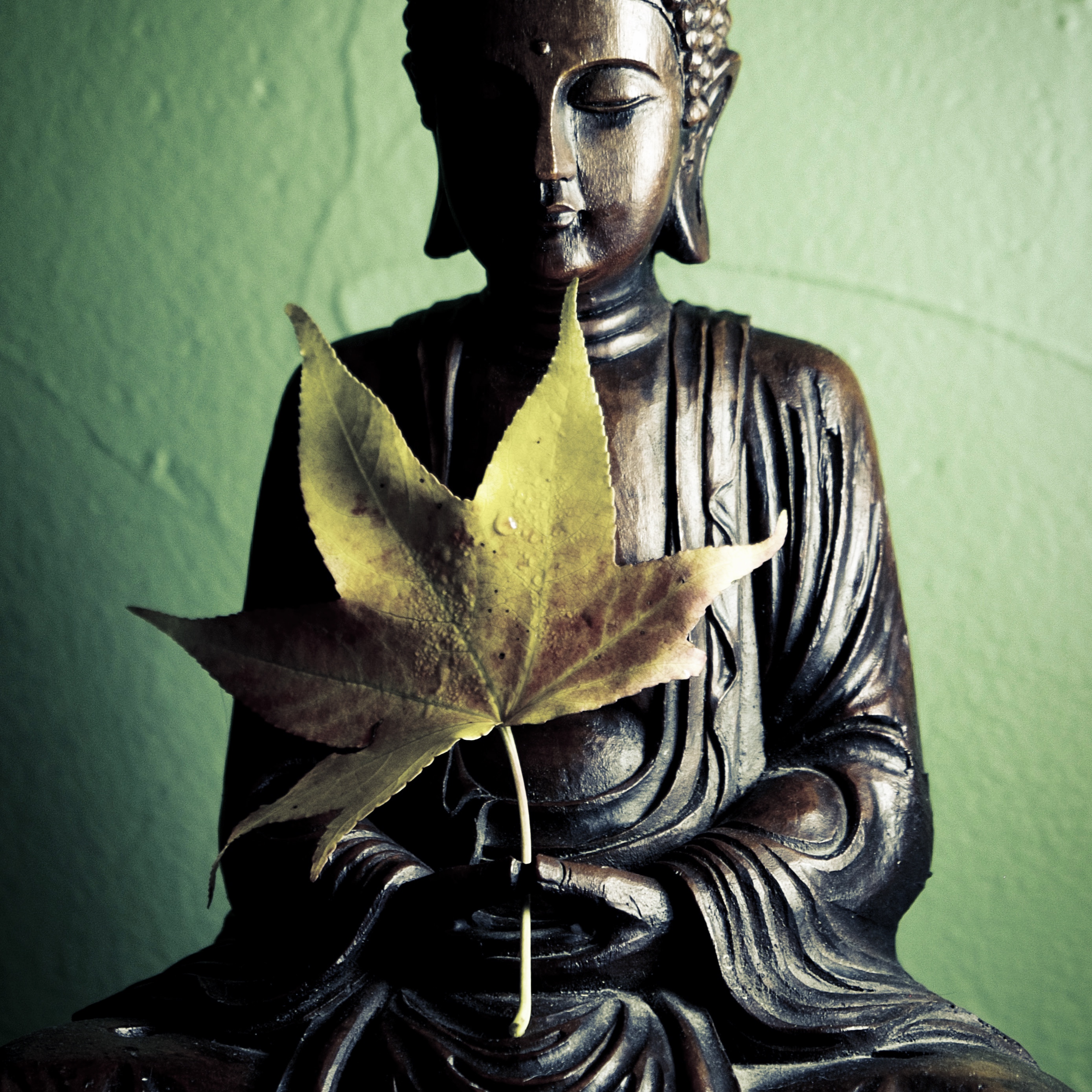
In the Eurocentric West, the emphasis has long been on identifying, developing, and embracing the individual self. One’s primary duty, perhaps one’s very reason for being, is to find himself, to know herself, and, perhaps, given the contemporary focus on self-esteem, to celebrate oneself. At the same time, a longstanding Eastern spiritual lesson is that any such “self” is merely a mental construct, an accomplishment of the ego. From a Buddhist perspective, the goal would be, not to develop the self, but to dissolve the illusion of it in order to experience the deeper truth of who one really is. Those of us who are simultaneously committed to identity-based social justice movements—on behalf of people of color, women, LGBTQ+ folks, and others—and to Buddhist principles may feel as if we are trying to occupy an incomprehensible (non)space. Should I aim to defend the identity story of the protagonist of my life narrative, or, instead, immerse myself in the cosmic freeflow where I am both everything and nothing? What I most love about “queerness” is that it helps me to make sense of these contradictory callings.
In fact, I think one of the most attractive things about queerness, as a concept, is how it sometimes thumbs its nose at the requirement for logical consistency. “Queerness,” it seems, is willing to defy not only Ockham’s Razor but also the law of non-contradiction itself. At its best, it’s a way of thinking that challenges the links between sex, gender, and desire so forcefully that it leaves us with more questions than answers. For me, to be sure, escaping the compulsion to define myself—for others or for myself—by reference to my body, how I speak and move, or whom I want to touch, has been gloriously liberating. Being able (at least sometimes) to abandon the project of making others or oneself feel more comfortable by self-defining in easily digestible ways—say, “I am straight or gay” or “I am a woman or a man”—can feel like a radically amped up version of discovering you can wear white after Labor Day. “Queerness” when we run with it philosophically, and don’t just treat it as a synonym for “LGBT,” can represent a dizzying disruption to accepted metaphysical assumptions.
Indeed, Buddhism itself can be thought of as involving a queering of identity precisely because it too dislodges and disrupts “common sense” metaphysical notions, in particular, of the self as ultimately substantive, solid, or real. The self is not, then, from this more Buddhist perspective, like a golf ball with a hard center that might be discovered after cutting away layers, but like an onion where nothing at all remains after the peeling. The point isn’t, of course, that the golf ball is more real than the onion, but that they represent different ways of modeling what is real. The essentialist view of identity, according to which there must be some substantive core that makes me me—even if it turns out to be a non-physical spiritual “substance”— can, from the Buddhist perspective, be regarded as a naive, fear-based belief. In other words, we are inclined to cling to the myth of a core self as if to a safety blanket. A more Buddhist view is that individual identity—my sense of being a distinct “I” with various qualities and characteristics—is almost like a sleight of hand trick. The “identity” of me is no more (or less) real than an apparently fully integrated and coherent movie character that has actually been built up from the movement of photographic frames in succession.
Some would say that, according to this more Buddhist view, “I” am not real, a claim that, understandably, can lead to anxiety and resistance. After all, thanks to our Eurocentric heritage, our inclination is to think that reality is an all or nothing matter: It’s true or it’s false. It exists or it doesn’t. It’s a fundamental error that leads to untold confusion and suffering, similar to the anxiety generated for some when it’s suggested that their sex, gender, and “sexual orientation” may not be real or enduring in the way they have assumed. Similarly to how some come to question their assumptions about the illusory nature of, and loose connection between, sex, gender, and desire, so too some are drawn to analyze the preconceptions and presumptions about who they fundamentally are as an “I.” Part of the beauty of queer thinking, I think, is how well it can prepare us for even deeper identity explorations, provided we don’t simply glom onto “queerness” as yet one more identity commitment. Of course, it’s especially tempting to treat queerness as just one more self definition in need of shoring up and defending when we feel persecuted because of our gender or sexual expression.
Given the tools we’ve got to work with and the fact that LGBTQ+ folks are under attack, it’s hard to imagine a better way to respond to such bigotry and persecution than to adopt a “rights” framework. This, in turn, seems to require some sort of identity-based politics. And so it makes sense that we encourage one another to “find” our “true” gender (even if it is, perhaps, to be no gender at all), to decide what sex we are (even if it is no particular sex at all) and to figure out for what sort of “others,” if any, we feel love and/or desire. With this in mind, the queer framework, born from a desire to shatter definitions and expectations about identity, almost inevitably becomes a scaffolding on which to rebuild identity, albeit one that may be more expansive and experimental. Biologically deterministic, assertively heteronormative sexuality may be the most common expression of psychological and spiritual insecurity—one’s identity confidently rooted in the unquestioned alignment between their sexual morphology, gender, and patterns of desire. But if we urge someone to embrace their queerness, do we not risk pushing them too toward the religion of substantive identity?

The best response I can come up with is that whatever identities we adopt or embrace—be it for aesthetic, political, psychological, or ethical motives—there’s good reason to consider wearing them lightly if and when our life circumstances permit. For me this mainly means paying particular attention to when I may be relying on an identity trope or commitment as an excuse to avoid going deeper. It also seems safe to say that, in general, the more seriously folks take Buddhist (and Vedantic) encouragement to dive deeper into their own subjectivity—with sitting meditation as the most common method—the less attached they tend to feel to more particular aspects of their identity such as “sexual orientation.” Of course, such identity commitments may wax and wane based on social and historical contexts. For instance, these days, I think to call myself lesbian or queer primarily to assert solidarity and build community, knowing that I enjoy extraordinary privilege relative to many other sex/gender outliers. In short, remaining socially engaged as a queer person and ally is important to me even if/as I do not quite feel myself to be defined by queerness as I know so many do.
So, despite the fact that I have long been both personally and professionally LGBTQ—as a professor this has been a scholarly and teaching commitment of mine—the queerest identity project I have ever undertaken has had nothing to do with dismantling sex, gender, or sexuality. It has had nothing to do with how I walk, how long my hair is, what clothes I wear, or whom I invite into my bed. Instead, my most radically queer project has been the deconstruction of myself as an egoic subject. These days, then, I sometimes hesitate before responding to questions like: “Do you prefer ‘lesbian’ or ‘gay?’” Do you think of yourself as existing on a trans continuum?” I have to pause, not because I am any less committed to LGBTQ people or to queer rights, but because, increasingly, I know the experience of residing in/as an undifferentiated openness beyond any thought of sex or gender. I do kind of consider myself to be an identity rebel, then, but only because I have discovered nothing queerer than what arises when I follow this tiny, timeless question as far as it will go: Who are you? Who are you really?
If you’d like to be notified by email of new posts, hit the menu button above to find the link to subscribe.
 OtherWise Philosophy