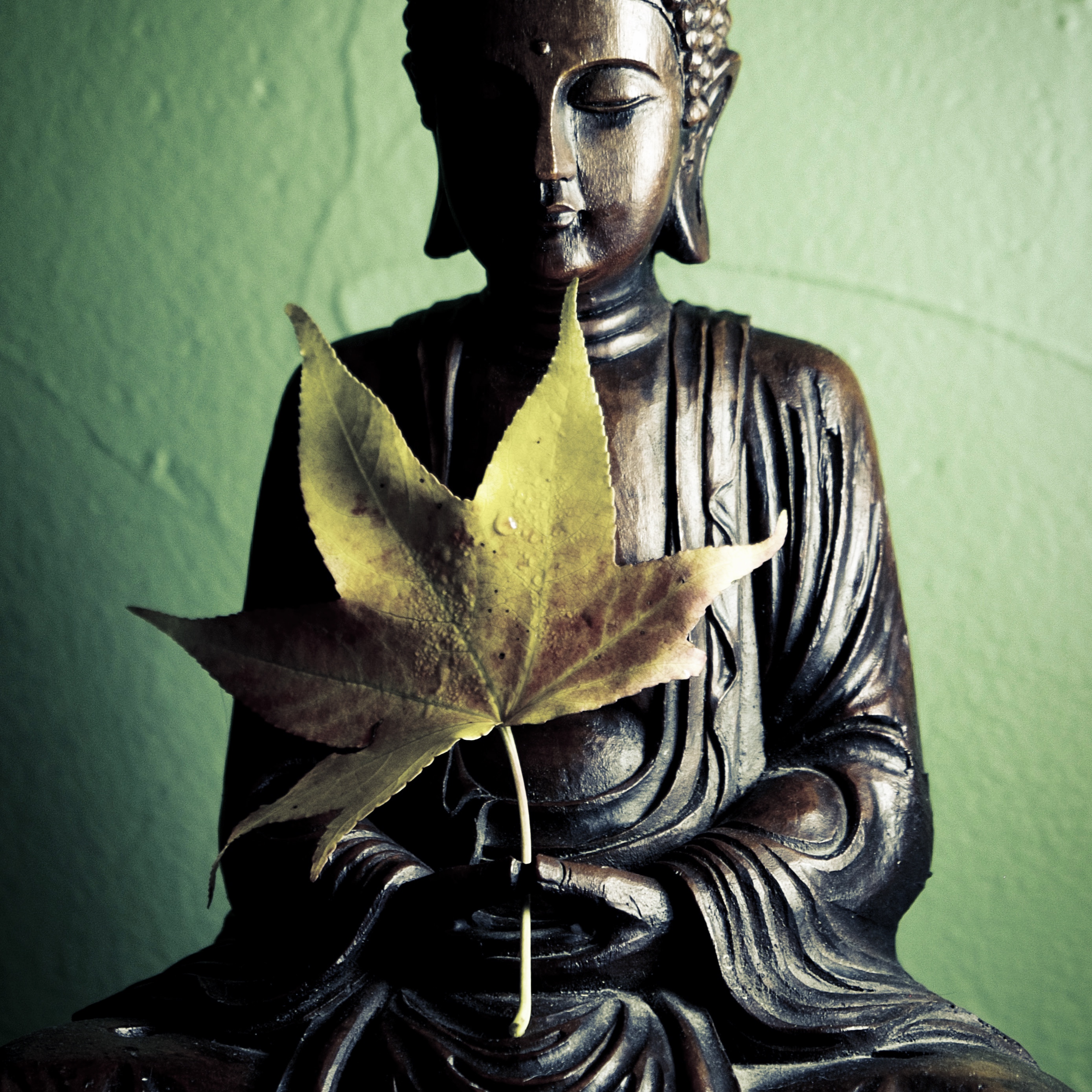
The student sat before me on the floor, both of us cross-legged, backs straight, for what was meant to be a brief, detailed, guided meditation. This was what she had requested, rather than the more free-form version I’d first recommended, because, as she explained: “I’m a really bad meditator.” When I assured her that almost everyone thinks they’re a worse-than-average meditator—an impossibility—she insisted that in her case it was really true. Minutes later, when she got so frustrated she gave up altogether, I told her it was fine, that being a “good meditator” was almost certainly not an absolute requirement for spiritual growth. She responded by enumerating additional factors about her own personality, character, and life circumstances that, she assured me, would indeed impede her spiritual path. Not only was she short on time and energy due to her job, small child, and husband, she said, but she had been left so scarred by a difficult childhood that she would never feel “safe” or “worthy” enough. “You don’t understand,” she said, despite the fact that I had put up no argument, “This is just who I am.”
Partly because I too have argued passionately for my own limitations, I now recognize this tendency as one of the greatest barriers to spiritual development. That we may feel frustration as someone else contorts themself, pretzel-like, in an attempt to rationalize their inability to take steps toward transformation is telling. At the same time, we may not even notice when we ourselves become entranced by our ego’s seductive song of why this or that growth activity isn’t doable. Not for “someone like me.” Maybe later. Once I work just a little harder, improve myself a bit more. We can, of course, hypnotize ourself into believing in our own limitations in various contexts: physical, psychological, financial, interpersonally, and, of course, spiritually. It shows up in the spiritual realm whenever I understand myself to be in exile, confident that the peace, serenity, and joy I associate with awakening must be reserved for “special” others. While there are, no doubt, all sorts of more or less plausible explanations for why we become so committed to self-limitation, it’s also easy enough to appreciate why we cling to this habit. It sort of lets us off the hook with respect to creating the life we may claim to desire.

Of course, the skillful response to such self-sabotage is not to shame people into become more self-determining. This wouldn’t just be lacking in compassion but also ineffective. People usually do what they do when they feel like it regardless of well-meaning others who might try to manipulate them to do otherwise. And there also really are causal realities associated with biology, psychology, society, and history. It is evident that we are shaped by material and social conditioning into the particular beings that we are. I cannot simply will myself to be taller, or teleport myself to the nearest star. Nor can I easily let go of deeply ingrained inclinations to be self-critical and skeptical, or to have a hard time sitting still. The Buddha too acknowledged the impressive force of social conditioning, recognizing that, for most of us most of the time, it exerts an inexorable causal momentum, like a heavy wheel that has been set in motion and continues to turn and turn. Something like freedom is possible, from this perspective, but the temptation to remain attached to a narrative of oneself as at the utter mercy of causal, karmic forces may feel as irresistible as falling back into a drugged sleep. This analogy is not accidental, for we can be said to be most asleep precisely when we most identify, defend, and perpetuate this limited, illusory self.
What can be especially frustrating for the spiritual student—I’m speaking from experience—is that it’s often when we’re closest to transcending identification with the small, egoic self that we may feel compelled to race backward into the ignorant bliss of a limited identity narrative. Then we become like a toddler successfully learning to walk who suddenly retreats back to her caregiver when she realizes how much distance she’s covered. This analogy, too, is not incidental since infants and children are known to willingly fall back into the familiar arms of a caregiver, even when that person is abusive. This phenomenon is often cited to illustrate the power of the human drive to cling to what is known, and to equate familiarity with security. As spiritual travelers, when we are nearing the edges of our mentalized and psychologized maps—as sometimes occurs during meditation—it is kind of natural for us to race fearfully back into our egoic selves. In those moments, we may be especially vulnerable to the ego’s undermining voice: “You are not ready.” “You could lose yourself if you continue forward.” “Practical people like you aren’t meant for ‘enlightenment.’” Don’t we believe such limiting mantras at least partly because they permit us to remain in our miserably comfortable cocoons?

When I first began my spiritual journey, I couldn’t grasp the fact that my own identity commitments would be my greatest obstacle. This amuses me now because nearly every teacher I had consulted, and every book I read had assured me that this would be the case. Over the years, it has only been in fits and starts that I have realized this truth, after gradually learning to notice when I have been defining myself in reifying, essentialist terms. Specifically, I began noting when I was inclined to use this preface: “I am the kind of person who…” This phrase (and others like it) is an alarm bell for me because I notice that what follows is likely to be an argument for self-limitation. These days, then, whenever someone thinks they’re telling me who they fundamentally ARE by listing physical, personal, and social factors and circumstances, I almost feel like I am watching an attorney arguing in a courtroom for their own guilt: “Do not be fooled by the fact that I appear to be reasonably whole, and more or less well-adjusted, for, in reality, the core of who I am is damaged and contorted beyond repair. Meaningful spiritual growth may be a realistic goal for others, but not for me.”
The creepiest part of all of this is, I think, expressed in a teaching I couldn’t let myself really hear for decades. In fact, it was fully thirty years ago when I first encountered the claim that one of the greatest barriers to alleviating our own suffering is that we may be kind of in love with it. Although this can be hard to hear—it was for me at any rate—it makes sense when we consider that our egoic identities are often built up around a core of suffering. When I assume that worry, anxiety, and insufficiency basically define who and how I am, then letting go of such thoughts and feelings can feel like self-abnegation. When suffering has come to feel natural and necessary to my identity, then, sure, I am going resist letting it go. From this perspective, announcing and underscoring my so-called weaknesses, flaws, and limitations—especially those that supposedly render me unfit for spiritual development—becomes a celebration of self, albeit a masochistic one. Further, it permits me to remain in stagnation, out of reach of my spiritual goals, but also to avoid responsibility for the choice I am making: “Oh, how I would love to taste of the peace I believe awakening might offer! If only I were a different kind of person.”
If you’d like to be notified by email of new posts, hit the menu button above to find the link to subscribe.
 OtherWise Philosophy