I get a text from a friend worried that something she texted me a few days ago might have bothered me. Even though she doesn’t precisely specify, I know what she’s referring to because I had laughed when I read it. Not at my smart, lovely friend, but at the surprise of it, of the fact that she came out and said it. “I used to do that too,” I think. I used to say more of what rose up in me, and sometimes I miss that younger version of me, the one I sometimes imagine as having been more spontaneous, less guarded. Sometimes I long to regain confidence in the power of argument, the attachment to language and concepts that I had as a younger adult, to believe it’s generally worth the trouble to “say the thing,” to be heard. But at least as often, as this battle-scarred, “mature” version of me sidesteps a disagreement, or leaves a room without saying much, I feel peaceful relief. The ambivalence I feel, poised on the tightrope between silence and speech, mirrors my own personal development over the years. It also reflects my dis-ease with interpretations of Buddhism as generally discouraging speech. In short, as a human being/woman-person with biological and social roots, who is also drawn to contemplative silence, I am all over the map when it comes to my thoughts about the role and value of speech.
Without getting too tediously autobiographical, I’ll note that I was one of those kids on the sidelines, those earnestly trying to decipher the rules before—maybe—joining in the reindeer games. A quiet watcher, I read the room, calculating risk, knowing, as the youngest child of very young, impatient parents, that anything I said might well be used against me. But I also seemed to have come into my little baby body hopelessly pre-infected by language. And so I spoke and read early, carried by words that swirled through my mind, and sporadically poured from my mouth in torrents, accompanied by gesturing hands that I tamed by sitting on them. I’ve spent much of my life, then, swinging between the fear of saying the “wrong thing,” on the one hand, and of being so drunk on the oh-my-god poetry of reality that I can barely contain myself. If there’s any accounting for the fact that I’ve been writing since I could hold a jumbo pencil, it is this: I was a no-account little girl born with a compulsion to “speak” in an environment in which children were meant to be neither heard nor seen. It is partly from her point of view—and the banged up adult she became—that I sometimes worry about the emphasis placed on right speech and noble silence. Such apparent spiritual virtues can so easily become rationalizations for unhealthy, abusive silence, or as a way to (further) shame the vulnerable into silence. Of course, because of the silencing power of racism and sexism, this disproportionately impacts women and girls, and people of color of all sexes and genders.

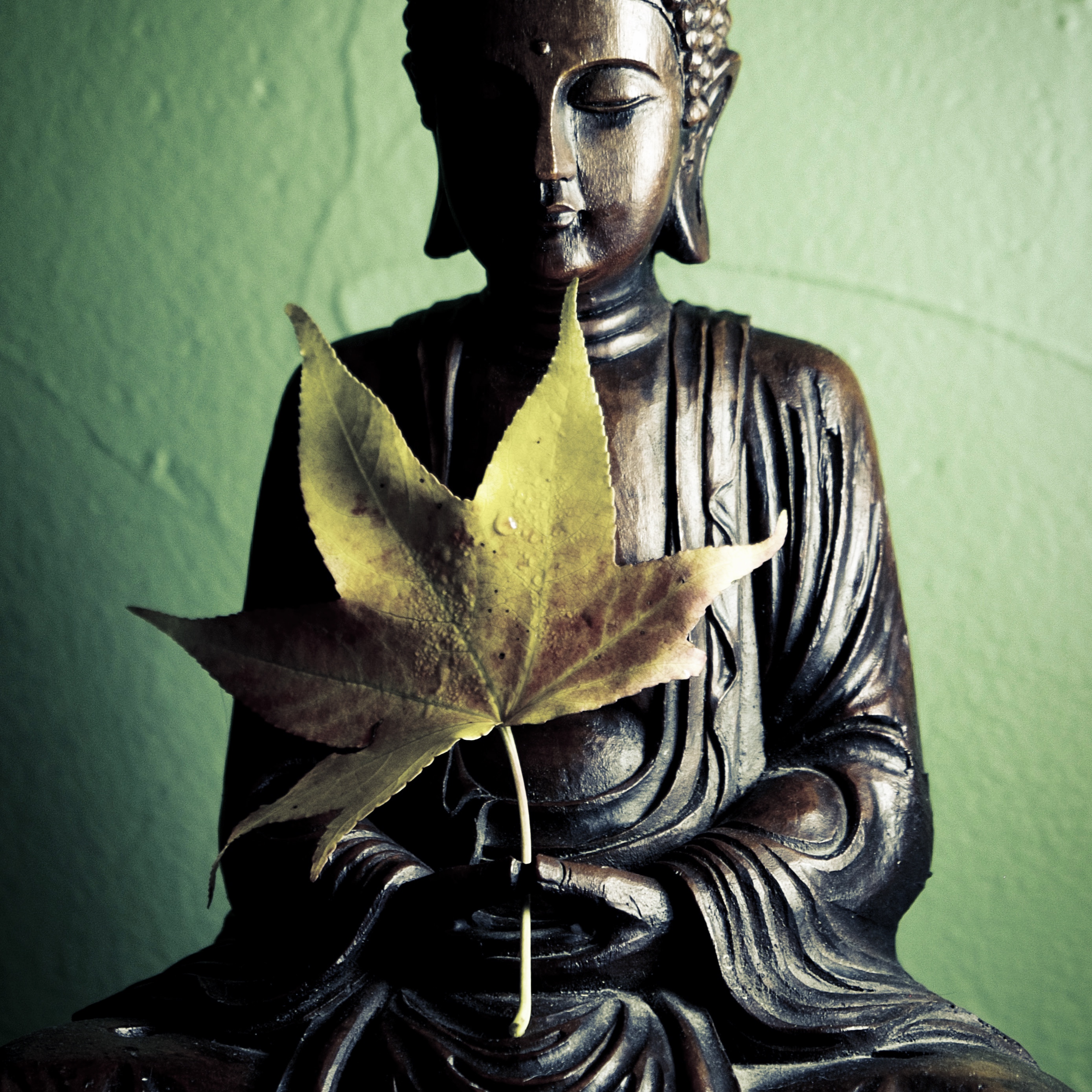
But, again, I’ve got nothing against wordless silence. I am also drawn to its beauty and regularly seek its sustaining company. I have walked alone for days along forest paths with only the skitter of birds and squirrels to keep me company. I sit here now alone precisely so that I may locate, and rest in, the liquid silence that lies behind my eyes, beyond the noise of my life, transcending the maddening, wordy chatter of social existence. It’s no accident that I have carried an image of Kuan-Yin, the bodhisattva of compassion for decades—first in my wallet and then on my phone— for I take comfort in the wordless peace that she radiates. From my point of view as a spiritual traveler, I know to the bullseye center of my soul, not only that no words are necessary, but that, ultimately, they are illusory. I know from my own meditative experience that who I truly am exists far deeper than words, which, inevitably, are relatively clumsy and plodding. Dropping into the deep well of silence moves me beyond mere belief and into a knowing/belonging that transcends the conceptual. I am, then, a spiritual teacher and student who believes in the dignity and necessity of cultivating and abiding in wordless silence, both internal and external.
But, as perhaps is true for all of us, I have also known (and used) silence in its less salubrious forms, as a hideout and defense, as a weapon and a lie. When it serves as a manipulation or evasion, then silence can run the gamut from petty to cruel. For instance, when faced by walls of silence from those whom we appropriately rely upon to cultivate our basic sense of belonging, then the damage can be acute. At a fundamental human level, we quite naturally form ourselves, become ourselves, in part, through the expressive and mirroring effects of language. In short, we seem to be deeply linguistic creatures, and not only as a social habit, but even inside our own heads. Our creaturely relationship to wordless silence, then, is complicated in ways that no one, certainly not the Buddha, can easily explain away. To the degree that I am making friends with my human nature on my spiritual path, then, I must also find a way to reconcile this tug between speech and silence, even if it is only to make peace with what may be irreducible contradictions.
The most common Buddhist way to make room for such tension is to contrast skillful speech from that which may be untrue, unkind, unnecessary, or untimely. And it surely makes sense that the Buddha provided a handy prescriptive list for those interested in spiritual training because, as all of us have probably learned the hard way, we cannot necessarily trust our instincts about speech. Especially in the early years of mindfulness, learning to explicitly stop and ask ourself before speaking: “Is it true?” can provide a useful gap, a “filter,” that can keep us from causing unnecessary harm. But for those whose superegos already overflow with lists of shoulds, I’m not excited about rules that may help reinforce deeply engrained, shame-based repression. Do those already biting their lips and sitting on their hands need to be handed another list to consult before opening their mouths to speak? Do people who’ve spent decades learning to give voice to their trauma and abuse need to be made more hesitant to open their mouths by more rule-givers? In such cases, is the risk of making a spiritual “mistake” really greater than that of pushing such tentative folks further into a silence rooted more in shame than in blissful solitude?
Sometimes I think that, more than helping me become more skillful in my speech, my awareness practice has made me less sensitive to careless speech, be it others’ or my own. I mean, yes, I have become less impulsive and clumsy with what I say and that’s great, but, even more transformative, I think, is that I don’t beat myself up so much when I do say something cockeyed or incorrect. These days, I am far more likely to simply apologize when I need to and then let it go rather than laying awake half the night beating myself up for being an idiot. Critically, this ability to forgive myself more often and more quickly for saying foolish things increasingly extends to others. And so I find that I also care far less than I used to about the apparently rash, nasty or ill-conceived thing that someone else says to me or about me. My feelings may be hurt by it, sure. I am as sensitively human as I have ever been, maybe more so. But I can now see so much more clearly that words do not fundamentally alter me that my attachment to the feelings they may engender—negative or positive—is looser and lighter.

These days, when I’m in the midst of a difficult, non-constructive exchange with someone and am inclined to continue speaking, I try to remember the time I spilled a full glass of red zin on white carpet in the home of people I barely knew. I reacted by grabbing a bunch of paper towels and madly blotting, apologizing profusely, as the hosts—casting meaningful glances to one another—weakly assured me that it would be fine. In my desperation to clean up my mess, it pretty quickly became apparent that I was probably making things worse, pressing the purple-red liquid deeper and wider. At some point, of course, I stepped back, but it took far longer than it should have. Some compulsive, controlling part of me desperately clung to the belief that, with just a little more rubbing, I could still fix it. Even though I may continue to be ham-handed at times with both my wine and my words, then, I have gotten much better at stepping away from the incipient disaster sooner, accepting that more verbal interjections from me are at least as likely to make things worse as better.
Paradoxically, this more realistic, humble view of the power and necessity of words in my life is also why I can now speak so much more freely of my love and admiration for others. Honest affection and praise sometimes spill from my mouth unbidden, sometimes from out of the blue, catching even me by surprise. “You are so beautiful,” I say, and I mean it. “You are brilliant,” I say, and I mean that too. “Wow, I love you,” I say, because I do, I do, I do. At such times, I am no longer a thinking-speaking hominid, calculating the social cost of syntax and semantics, but a blackbird trilling at dawn. In such moments, I become a dancer with legs and arms made of pure, undulating waves of sound. When my conditioned mind takes its seat at the back of the auditorium and leaves the stage to me, worries about speech and silence dissolve away. All supposedly spiritual rules become like just one more out-breath, the exhalation of a universe that breathes me into spontaneous being in each new now.
If you’d like to be notified by email of new posts, hit the menu button above to find the link to subscribe.
 OtherWise Philosophy