The first time I walked into a pour-over cafe about a decade ago, I couldn’t get over the absurdity of it. At various stations set up throughout the customer area, hipster employees methodically circled matte black kettles over cups as if performing an incantation. In the usually-ebullient dining area, the silence was church-like as the baristas performed a rite that, at that time, few customers had seen before. I filed the experience away under food-n-drink fads I had no desire to invite into my life. Some years later, though, a friend ordered me a pour-over at our usual place and I was struck by its complexity and sweetness. I couldn’t stop gushing over it as I sipped. My friend insisted that its deliciousness was due to its being a pour-over rather than the whatever-it-was I usually ordered. And it’s not that I didn’t believe her—at the very least, I knew I was too ignorant to dispute her claim—but nor did I actually accept it. It wasn’t until I started hearing folks wax poetic about the “meditative” process of making pour-over coffee that I really started to get curious.
Fast forward a few years and I’ve fallen happily into the pour-over universe, utilizing scale, beaker, various kinds of drippers, and a temperature-variant gooseneck kettle that makes my kitchen counter look like a chemistry lab. I’ve become fussier about my beans too, driving across town to secure the most freshly roasted coffee. It’s gotten so intense that, as often as not, like a kid laying out her clothes on the eve of the first day of school, I’ll set up my chosen coffee brewing configuration the night before. This is partly to minimize the error a cloudy morning-brain can generate, but also because sometimes I am just THAT excited about making my next cup of coffee. In fact, sometimes when I wake up in the night, I find myself planning the small adjustments I might introduce the next morning, say, a coarser grind, a slower pour, hotter water, or maybe just another half-gram of coffee. And while I’m no stranger to obsessive hobbies, this one attracts me at several levels, so I found the prospect that it might also be “meditative” delightful. Could it be that while I’m satisfying my morning coffee craving I might also be earning credit for spiritual development?

Of course, depending on the definition of “meditative,” just about anything might qualify. Here’s a very incomplete list of activities people sometimes describe this way: yoga, dancing, walking in nature, doing jigsaw puzzles, knitting, sewing, painting (both canvasses and walls), playing an instrument. Then too there’s video gaming, and various other kinds of games and sport, from basketball to bowling to surfing. In terms of practical activities, there’s baking and cooking, as well as vacuuming, ironing, folding laundry, washing the car, gardening, and yard work. At the most generic level, “meditative” seems to describe activities in which one can “lose oneself” to some degree, that is, disengage from their internal mental thought-stream and become “one” with the doing. I think it’s probably similar to what’s meant by being “in the zone” or in a “flow state.” Because, for most humans, the default tendency is to be identified with a nearly constant barrage of thoughts—especially about what we like or don’t like, or what we need or don’t need—merely feeling one’s consciousness unstick from thought and onto some other anchor, can provide much-needed relief, if not deep pleasure.
At any rate, the “meditative” value of doing pour-over coffee—or any of these other activities—may be more or less the same as that of many sitting meditation practices, especially those where one is focused on the breath, a mantra, or, perhaps, a candle. Consciousness is basically being provided with an object—the breath, a word, a flame—as an exercise in detaching it from its usual fetish object: the internal chatter of thought. And, as most of us have experienced, depending on the degree to which we tend to be habitually caught up in our thoughts, it can feel amazing, revolutionary even, to gain even this little bit of space between our “I” and the compulsive, relentless flow of mental speculation, wondering, and judgement. As elephants are sometimes given a stick to hold to keep their curious, wandering trunks from idly wreaking havoc, so too giving ourself certain kinds of distracting “objects” can be very helpful. When such “objects” include repeated (and repeatable) actions/activities—especially if these are rhythmic or patterned—they can quite naturally transform merely habitual actions into an actual practice, with all of the discipline and intentionality that “practice” suggests.
The potential pour-over coffee-making has to function as a genuinely intentional, dignified practice is not surprising since the ritual significance of food and drink runs deep in our species. Whether it’s a simple blessing offered before a meal, or the sanctification of a communion wafer, humans have an inclination to give ceremonial meaning to the process of bringing foods and liquids into our bodies. (That is, when, we’re not simply shoving it into our pie-holes as we pull out of a fast food drive-through.) We’re also sometimes inclined to confer meaning to eating and drinking by associating these activities with aesthetic value. “Plating” food, for instance, is quite obviously an art and, of course, being a competent professional baker or bartender often has as much to do with the appearance of one’s creations as their taste. From this point of view, making pour-over coffee is on the far opposite end of the spectrum from, say, flipping the switch on a Keurig. Whereas pod-coffee is intended to remove the subjective human “variable” from the process, with pour-over, one’s judgement and interventions are critical at every turn. Pour-over might also be described as slow food philosophy applied to coffee, then, a rebellion against the notion that securing food, and that eating and drinking it, should be as “efficient” as possible.
Still, I’m a little lukewarm about the eagerness to describe so many activities as “meditative,” including pour-over coffee-making. For one thing, the pour-over world—as a quick perusal of YouTube will confirm—is chock full of folks who, like me, have clearly crossed the line from being mindfully attentive to being, let’s say, hyper-focused. I speak with authority since I myself regularly fall down such nitpicky rabbit holes, wending my way through lengthy comment threads with earnest debates about sometimes trivial micro-adjustments to recipes or methods. While they may be supporting a healthy attention to coffee-making detail, the proliferation of technique-oriented coffee experts also provide infinite avenues of potential distraction to those of us seeking the ever-elusive holy grail brew. It’s an all-but-guaranteed perpetuation of ongoing desire for those of us caught in the duhkha-loop. Predictably, what may begin as an exercise in simplicity and mindfulness can easily devolve into an expensive, incredibly complicated, compulsive exercise as folks seek ever-better tools and methods to arrive at coffee nirvana.
What most catches my attention about the “meditative” label, though, is that it sometimes seems like quasi-spiritual verbiage is being recruited to provide a sort of productivity-oriented rationalization for indulgence. This, of course, is a thing we humans often do. Whether it’s about coffee or wine, intellectualized framings—say, esoterica about the rules and rituals of tasting, the nuances of terroir and preparation style—can overshadow, rather than support, the experience of basic somatic pleasure. Part of the point, it sometimes seems, is to deflect from the fact that the actual goal is mostly connected to leisure and to fulfilling mundane embodied desires. For those of us who think of ourselves as diligently walking a path of spiritual development, it can be especially tempting to reframe every part of our life in spiritual terms. It’s as if it’s not enough to walk in the woods simply because it gives us bodily joy or because it’s relaxing and so we specify that it’s “meditative.” We get a massage, not for the sheer pleasure of feeling human hands on our body, but because it’s “meditative.” It’s almost like we’re clarifying that what we’re doing isn’t just idle hedonism, but bona fide spiritual work.
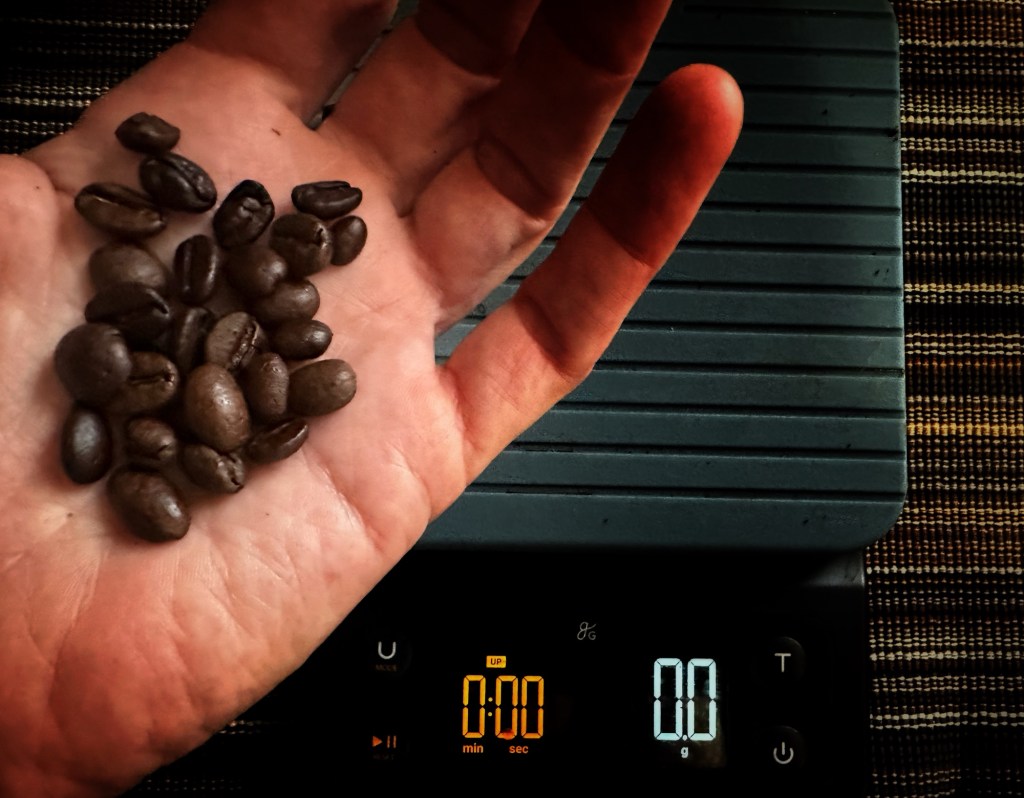
All this to say, then, that, right now, I find pleasure in my pour-over coffee-making hobby and in the drinks I make, whether or not it’s “meditative.” I like to monitor the orderliness of my countertop work-station, same as I liked to maintain the demarcated layout of my Barbie camper when I was six-years-old. And since I’m a mere human being who sometimes feels tossed around by the vicissitudes of, you know, life, I enjoy the feeling of control as I weigh out the beans to a perfect 15 grams and set my kettle to hold steady at precisely 205 degrees. I also like the pretty spiral patterns as I pour the water—gently, gently, gently—and the way the gas bubbles rise up while the coffee grounds “bloom.” Sometimes I lean against the wall, standing on one foot, totally zoned out, while the rich brown liquid finds its way out of the dripper. Other times, I’m recalling a dream, making mental notes about the day to come, or looking for the right word for a poem I’ll never write. Sometimes, yeah, I’m just totally at one with the drip-drip-drip. So while I can’t deny the “meditative” potential of pour-over coffee-making, nor am I inclined to ask of this particular activity that it earn its place in my life by performing such lofty spiritual work.
If you’d like to be notified by email of new posts, hit the menu button above to find the link to subscribe.
 OtherWise Philosophy