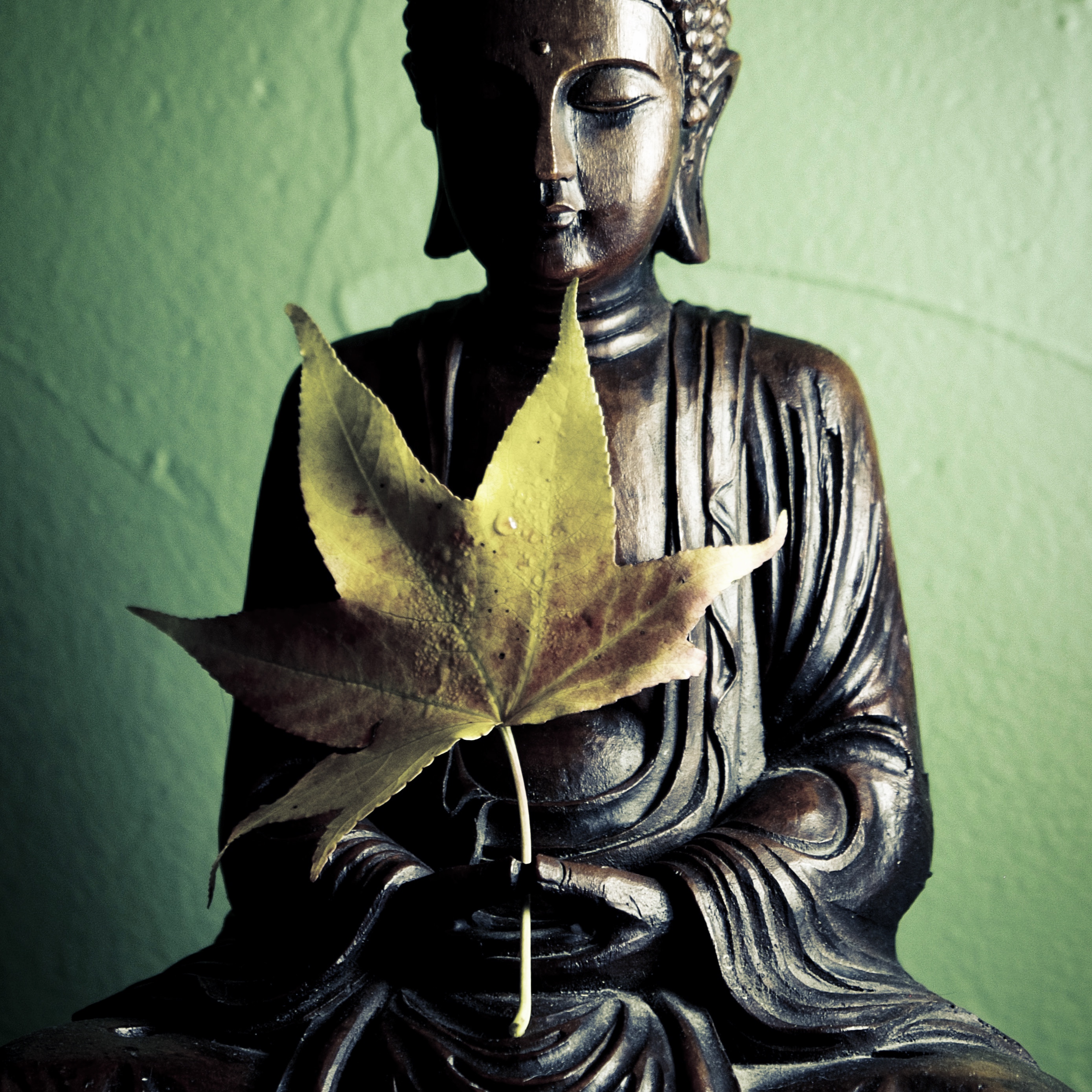
In my corner of the world, not-meditating has come to be viewed like other common “bad” non-habits, such as not-eating green, leafy vegetables or not-exercising. So I’m rarely surprised anymore when I first meet someone who knows about my interest in meditation and they speak to me as if I were their confessor. Occasionally, the actual very first thing they say to me is: “I know I should meditate, but…” And I get it. For one thing, owning up to such “lapses” can ease the guilt of failing at yet another self-improvement expectation. Such proactive self-admonishment may also be a conscious or unconscious performance—for one’s own benefit and/or others—like the over-drinker who posts images of his pretty cocktails on social media: “That I’m so open about my drinking confirms that I don’t have a real problem.” And I suspect that some such unsolicited mea culpas are simply meant to reassure the speaker themself that, while they may not actually meditate, they are at least evolved enough to know that they should. Whatever else it may indicate, such apologetic references to meditation suggest that these folks hear a call to practice, however faintly.
I understand first hand the inclination to ignore and postpone that call. In fact, my curiosity about not-meditating initially arose from my own capacity for procrastinating this activity I “knew” I “should” do, and it prompted an exploration that has led me down lots of philosophical rabbit holes, including some pretty tedious ones. For instance, I’ve frittered away whole hours considering what it means simply to WANT, concluding that, as terms go, “want” pretty much begs to be abused through equivocation and conflation. But that’s not exactly news. It’s pretty obvious that, for example, some who insist they WANT to meditate don’t really want to, not in any meaningful sense. And this isn’t just liars, but earnest people too. Given the likely assumptions, presuppositions, and expectations many wannabe meditators have about meditation—some of which I too have held along the way—it’s pretty reasonable that they don’t REALLY want to do it even if they want to want to.

Unfortunately (from this point of view), one of the greatest barriers to developing a meditation practice is that many of us need to get at least a little bit good at it to experience the benefits that provide the motivation to stick with it. Further, because the true activity of meditation is individual and subjective—directly accessible only to oneself, and even then only potentially—there may be a more or less extended period during which the meditator must take it on faith that meditation is worth the bother, that something worthwhile is actually happening in there amid the uncomfortable chatter of one’s own neurotic (perhaps) thoughts. This helps account for why it can be so helpful to have a trusted teacher or friend whose practice is already successfully underway: witnessing the apparently positive impacts of meditation on another may be as good as it gets at first.
It’s fair to conclude that when some assert that they want to begin to meditate, then, they actually mean that they want to want to. Or maybe instead of wanting to meditate, what they truly want is to BE a meditator. At least that’s how it was for me before I developed a practice with enough momentum to generate organic internal motivation. And this is pretty common when it comes to all sorts of new habits, especially ones that, although the destination may be desirable, the steps leading to it are less so. So, for instance, the guy who wants a more muscular body may balk at changing his diet and activity level in the ways he believes necessary. Still, when it comes to bodily or physical “improvements,” it’s often easy enough to appreciate how the proposed actions might lead to the desired outcome. For example, not only are the supposed social and health benefits of diet and exercise well publicized, we probably know people who have reaped such rewards or have done so ourselves. As self-improvement goes, “fitness” projects are relatively straightforward. That so many of us struggle to develop even somewhat consistent health and wellness routines, then, should give us pause about meditation, for which the efficacy and underlying mechanisms are murkier.

After all, even if we have long been aware of the much-vaunted transformative powers of meditation in some distant, abstract sense, for most of us, it is still fundamentally mysterious. For the most part, “mind” remains a generally underexplored, poorly understood landscape, including for scientists and philosophers who specialize in this area. By contrast, part of why we may easily be willing, say, to avoid eating certain foods in order to discourage heart attacks is that the physical mechanisms have been drawn with cartoon clarity: the heart as a pump with gunk depicted as clogging up the connecting “pipes.” Not that this picture is scientifically accurate, but it does fit pretty seamlessly into a familiar causal, materialist, and naturalistic framework that lends intuitive plausibility to the new eating regimen.
But given how unsatisfyingly the model of “mind” (and its relationship to “matter”) has been rendered in the West, by what mechanism is mentally “watching” one’s breath supposed to accomplish anything? How is the “observation of thought” supposed to work? Is one ultimately meant to persuade their ghost-in-the-machine mind to behave better? And if the “problem” really is a recalcitrant and rebellious wisp of a mind, then why not simply exercise the will, as one “makes” their hand reach out to pick up a pencil? And who is the “I” behind all this anyway? Am I the mind itself or something more transcendent and further removed? Naive dualistic assumptions about identity and the basic nature of “mind and matter”—still dominant in Western religion and popular culture—combined with notions about how these two “entities” might relate—do little to make meditation more convincing or appealing. Further, the implicit assumption of the brain/mind as a sort of Mission Control adds to the potential for shame, as one’s struggle to wrangle the mind into submission may be interpreted as proof of insufficient self-discipline. When I consider meditation from this perspective, I’m impressed that anyone is ever pushes through the psychological barriers and philosophical incoherence to actually just damn sit and meditate.

And up to this point, I’ve gestured only toward the most straightforward motivation to meditate: to improve health in some general sense. I’ve done so mainly because it’s so familiar and the basis on which meditation is successfully sold to many Westerners. But therapeutic relief or reward is obviously not what primarily motivates others, to the extent that we have even explicitly grasped and embraced these “true” motives. And, to be sure, I don’t assume that contemplative/spiritual seekers are necessarily more in touch with, or willing to claim, what truly impels them to meditate. For instance, I notice that I’m sometimes uncomfortable sharing that I’m at least partly aiming for liberation in the Buddhist sense. In the largely secular, pragmatic milieu in which meditation thrives around me, it can feel pretentious (at least) to admit that I’m not merely interested in “self-improvement” but also, um, nirvana. Whatever one’s actual motives for meditating—or, perhaps, for wanting to want to—for some, gaining clarity about such beliefs can help generate enthusiasm for the practice, as signing up to run a marathon may energize one’s daily running routine.
And at least occasionally exploring the basis of our desires regarding meditation can be helpful for other reasons too, even if it may not be wise to decisively pin our motives down. For example, although most incipient meditators I meet initially express a wish to alleviate “normal” stress, a fair number go on to unearth a deeper longing associated with the vicissitudes of existence as such. And, spoiler alert, such realizations often seem to result from meditation. After all, for some, meditation may be the only time they are subjectively focused enough that such heavy “existential” misgivings permit themselves to be seen. Even as we attempt to get in touch with our motivations, then, they may well be changing quite naturally as our practice unfolds. One initially takes up meditation, say, after a heart attack, but sticks with it for the sense of peace it seems to generate. After further practice, glimpses of apparently transcendent insight may arise that push one’s interests into more metaphysical territory. Or maybe not. In any case, engaging diligently in the practice—rather than primarily ruminating about it—is probably the best means of exploring the (perhaps evolving) reasons for whether/why one wants to—or thinks they “should”—do it at all.

That I will close this essay by urging that newish meditators approach the call to meditate simply and directly—through actual practice—rather than primarily as a philosophical, psychological, scientific, or religious project to be “understood” may be as unhelpful as it is unsurprising. Is my “advice” really nothing more interesting than “just do it”? Kind of. Because although it can be useful and interesting to assess thoughts and beliefs about meditation—and, as a philosopher, that’s my inclination—it can also function as a procrastination strategy. I count myself as incredibly fortunate, then, that the pragmatist inside of me first rose up decades ago, an inner voice pointing to the dangers of intellectualizing: “Stop thinking about meditation and simply do it,” that voice urges. “Don’t get so seduced and sidetracked by the smartypants scientific and philosophical literature about meditation that reading becomes your excuse for not meditating.” I am inclined to trust this voice because I recognize it as the same one that, in my 20s, had urged me to stop reading about smoking cessation and actually just cease.
And since this wise sliver of my own mind—is that who this is?—knows me so well (it is also privy to my more hidden mystical and romantic streak) it warns me too about the attraction of spiritual ceremonialism and how, for people like me, that too can distract from basic meditation practice. That such cautionary thoughts arise in my own “mind” creates a paradoxical form of reassurance and encouragement, because it is meditation itself that reveals my mind to be such a frequently unreliable, self-serving, and distracting “guide.” Isn’t it the mind, after all, that comes up with all of the compelling rationalizations for why we don’t really need to do it? “Not yet,” it whispers, “maybe later.” So when my own mind is willing to help bust itself by nudging me to meditate, it feels like a moment of grace that deserves respect. Then the mind is like the liar who, having tired of the charade, steps out into the light and removes his mask, confessing to the one he has been duping all this time: “Stop listening to me. It is time to go and see for yourself and trust your own experience instead.”
If you’d like to be notified by email of new posts, hit the menu button above to find the link to subscribe.
 OtherWise Philosophy